Are you interested in participating in OCD research? See below for current studies recruiting participants in southern California. Note that some research studies may offer treatment at no cost and/or provide compensation for research assessments.
Transcranial Magnetic Stimulation and Psychotherapy for Treating Obsessive-Compulsive Disorder
Study Overview: The Frank OCD Research Lab at USC Keck School of Medicine is examining how people with OCD respond to noninvasive brain stimulation when it is combined with psychotherapy. The study will also examine how day-to-day behavior and physiology, measured from a wearable biosensor, can be used to improve treatment outcomes for individuals with OCD. Study Length: 16 weeks Number of Visits: Daily in-person rTMS for 6 weeks (30 min), twice weekly virtual psychotherapy (45 min), 2 in-person brain scans (30 min), once weekly virtual clinician-administered survey (15 min), 3 virtual clinician visits (30 minutes), daily survey sent via SMS-based text messaging (~5min). Procedures: Repetitive Transcranial Magnetic Stimulation (rTMS), Psychotherapy, Surveys (clinician- and self-administered), Functional Magnetic Resonance Imaging (fMRI), Fitbit worn 24/7. Eligibility: Participants must have a diagnosis of OCD; live in Southern California and be able to attend in-person visits daily for 6 weeks; have previously tried Exposure and Response Prevention (ERP) therapy; be currently taking or have previously tried medication for OCD; be willing/able to pause therapy for the duration of the study. Compensation: Participants will receive compensation for their time and effort and will be able to keep the Fitbit at the end of the study.For questions about this study, please contact:The Frank OCD Research LabUSC Keck School of Medicine(323) 442-3632franklab@usc.edu
Research Study on Why Exposure Therapy Works for OCD
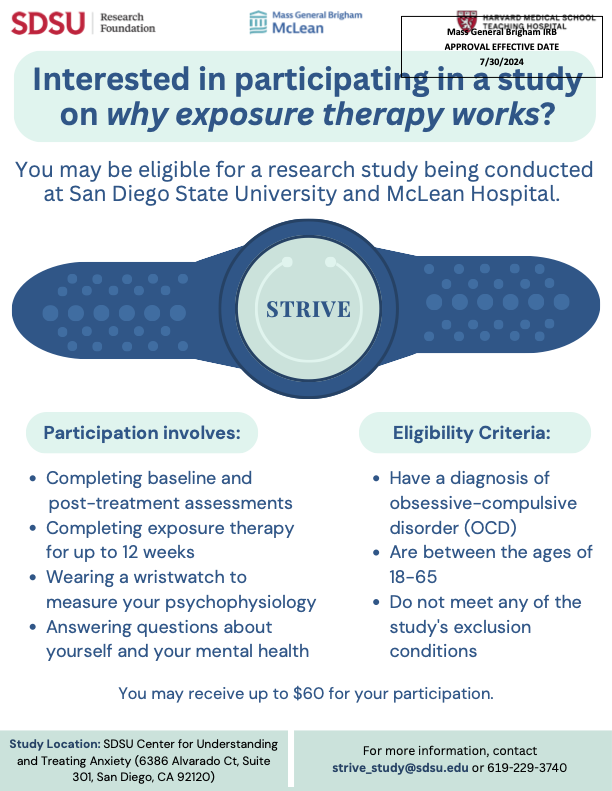 San Diego State University (SDSU) is conducting a research study on why exposure therapy works for people with obsessive compulsive disorder (OCD). Participants will complete up to 12 weeks of exposure therapy, as well as baseline and post-treatment assessments. During each exposure therapy session, participants will wear a wristwatch measuring their psychophysiology. Treatment will be provided at no cost, and participants may receive up to $60 compensation. This study is a multisite clinical trial that is funded by the National Institute of Mental Health and being conducted by researchers at McLean Hospital (PI: Dr. Jennie Kuckertz) and SDSU (Site PI: Dr. Nader Amir).
Do you have OCD? Are you over 18 years old? Have you disclosed your OCD to others?
individuals who have obsessive-compulsive disorder (OCD). The study involves a brief,
anonymous questionnaire about your experiences of and attitudes toward disclosure and your
OCD symptoms.
To participate, please use the link below: https://bcmpsych.sjc1.qualtrics.com/jfe/form/SV_cUeP1Mhm7R8eGKW
any private or personal health information.
Tracking Obsessive-Compulsive Disorder (OCD) symptoms and predicting response to treatment using Fitbit, neuroimaging, and smartphone surveys
Latin American Trans-ancestry INitiative for OCD genomics (LATINO) Study
Baylor College of Medicine and University of North Carolina would like to present the Latin American Trans-Ancestry Initiative for OCD Genomics, or LATINO. Led by Drs. James Crowley and Eric Storch, this new study seeks to collect the world’s largest ancestrally diverse sample of OCD cases (N = 5,000 Latin American individuals). This study will feature international collaborations with OCD clinics in Argentina, Brazil, Canada, Chile, Colombia, Ecuador, El Salvador, Paraguay, Peru, Bolivia, and Mexico, as well as OCD clinics in the U.S., including Houston, Miami, New Jersey, San Diego, and San Juan, Puerto Rico. This monumental study will address the current Latino representation gap in OCD genetic research by conducting a novel, wide-scale OCD genomic study with robust phenotyping. We hope that increased representation of Latin individuals will advance our ability to detect, diagnose, and treat individuals of Latino ancestry using precision medicine, as well as contribute to the diversification of OCD genomics as a whole. For more information on how to participate, please feel free to reach out to the project team at latinostudy@bcm.edu to learn more about our research and to find out how you could become involved, and/or click here: https://orit.research.bcm.edu/
Are you an adult in the United States with hair pulling disorder (HPD) or skin picking disorder (SPD)? Do you own a Keen2 device? If so – you can volunteer for research!
A graduate student at Harvard Extension School is conducting a study using the Keen2 bracelet (by HabitAware) to test whether a new habit formation technique can help people reduce HPD/SPD symptoms. Eligible participants must already own a Keen2 device, have symptoms of HPD or SPD, live in the United States, and own a mobile phone with which to access study surveys. The study will involve wearing your Keen2 device daily and answering brief study surveys over a 28-day period. To find out more information and sign up to participate, please click the link below: https://harvard.az1.qualtrics.com/jfe/form/SV_9KQL9KHcvXkpRz0
Patient Perspectives on Neurocircuitry Procedures for OCD
Researchers at Brown University are conducting a survey to evaluate patient perspectives and attitudes toward neurocircuitry procedures (e.g., neurosurgery and TMS) for individuals with OCD.
To learn more and complete the survey, click here: https://redcap.carene.org/surveys/?s=FXA4HHDEKE
Study on the impact of COVID-19 on Children with OCD Ages 7 to 17
Case Western Reserve University, under Dr. Amy Przeworski, is conducting an online study to examine psychological symptoms in children 7-17 years old. The goal of the study is to learn more about the impact of COVID-19 on children and their families.
For this study, they need families of children with OCD and families of children who do not have the disorder.
To participate in the study, click here: https://cwru.az1.qualtrics.com/jfe/form/SV_8678F95dgxjCcm1
For the flyer and more information, click here: http://ocdsocal.org/1838/1838/
New Investigational Medication Study
Join an exciting new study in the treatment of OCD. There hasn’t been new medication released for OCD since 1997. Biohaven is studying an investigational medication that modulates glutamate and would like you to know more. If you would like further information or would like to participate, please visit https://secure.treatmyocd.com/biohaven.html to get connected with a site near you.
OCD and Family Study
OCD is often linked with elevated family stress and burden. However, little is known about romantic relationships and parent-child relationships in adults with OCD. Researchers at the University of South Florida are conducting a study to better understand how OCD influences parenting behaviors and romantic relationships and to shed light on specific familial issues relative to OCD. If you would like further information or would like to participate, please visit https://www.facebook.com/
To learn more about how to participate in studies being conducted nationally, visit the IOCDF research participant page.